NFlow beta
Build models visually, then generate code you can read and maintain.
NFlow is Nelson’s visual environment for building, simulating, and generating code from block-diagram models. You assemble a model from a palette of blocks, wire up signal flows or physical networks, simulate it, and inspect signals on scopes and dashboards. When the model is ready, NFlow turns it into clean, portable source code that you own: embed it in your own application or firmware, or run it on its own.

Build
- A palette of blocks: sources, mathematics, logic, continuous and discrete dynamics, signal routing, and sinks.
- Causal signal-flow modelling and acausal physical (Modelica-style) networks on one canvas.
- Subsystems and masks for structuring large models.
- A scripted model API (
new_system,add_block,add_line,set_param, and others) for building and editing models from code.
Simulate
- A shared numerical engine with fixed-step and variable-step solvers (ode1, ode4, and ode45), plus a DAE backend for acausal networks.
- Event and zero-crossing handling, and algebraic-loop solving.
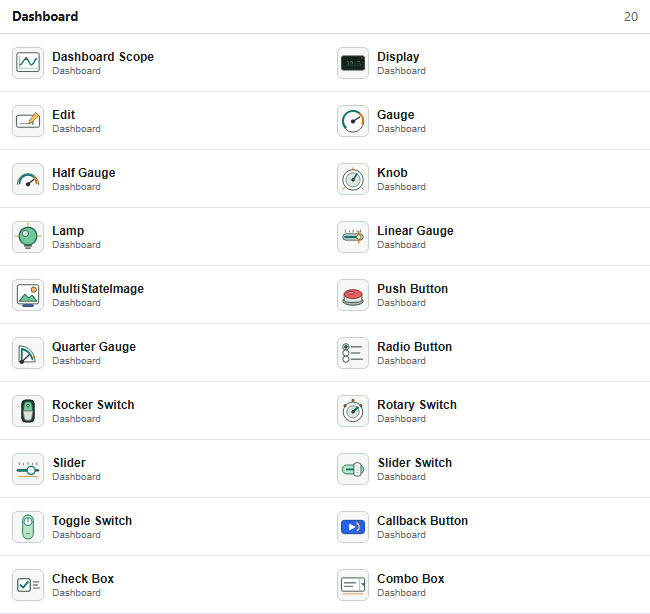
- Live scopes and interactive dashboards, including gauges, knobs, switches, lamps, and displays.
Generate C and Rust
Any supported model generates to C and Rust that build and run outside Nelson and match the interpreter to near machine precision. Models that use features which are not yet available for code generation (the variable-step and DAE solvers, FMU and Modelica blocks, or Nelson-function blocks) are rejected cleanly, with typed messages naming the offending block, rather than producing silently incorrect code.
The generated code has no runtime dependency. A model becomes a small, reusable API: a
ModelState struct and nflow_init, nflow_step, and nflow_terminate functions, with one
input field per external source and one output field per sink. Code generation is therefore
not only for standalone programs: you call nflow_step from your own application,
library, or real-time control loop. A runnable main (a CSV writer) and the build files
(CMakeLists.txt for C, Cargo.toml for Rust) are emitted too, but they are optional.
Rust that runs on bare metal (no_std)
The generated Rust core is a #![no_std] crate: it needs no operating system and no
allocator. Its maths go through the libm crate, so it compiles for any target that provides
libm, including bare-metal microcontrollers, an RTOS, and WebAssembly. The crate is split
in two: lib.rs is the no_std model core you deploy, and an optional main.rs is a
standard host runner that adds file I/O and command-line arguments. For a microcontroller,
the deployable artefact is the library.
The supported solvers are the fixed-step ode1 (Euler) and ode4 (Runge-Kutta 4) and the embedded adaptive ode45 (Dormand-Prince 5(4)), with zero-crossing surfaces localised by bisection exactly as in the simulator. Every generated model is verified locally: it is compiled, run, and compared against the simulator sample for sample.
% Generate C (the default), then no_std Rust, from a model file.
nflow_codegenerate(model, destination, true, 'C');
nflow_codegenerate(model, destination, true, 'rust');

% Core only, to embed in your own project (no main, no build files).
nflow_codegenerate(model, destination, false, 'rust');
Interoperate
- FMI and FMU import and export for co-simulation.
- A stable, versioned
.nflowmodel format, with guaranteed forward-readability for published models.
NFlow currently ships as a public beta. The model format is frozen at beta level, and a final 1.0.0 release will add golden-file coverage in continuous integration.
See what else is new in 2.0, or download Nelson.