imbinarize
Binarize image using a threshold.
📝Syntax
BW = imbinarize(I)
BW = imbinarize(I, T)
BW = imbinarize(I, 'global')
BW = imbinarize(I, 'adaptive')
BW = imbinarize(__, 'Sensitivity', value)
BW = imbinarize(__, 'ForegroundPolarity', polarity)
📥Input Arguments
Parameter Description
I Input image.
T Numeric threshold. It can be scalar or the same size as I.
method Binarization method: 'global' or 'adaptive'.
'Sensitivity' Sensitivity passed to adaptive thresholding.
'ForegroundPolarity' Foreground polarity for adaptive thresholding: 'bright' or 'dark'.
📤Output Arguments
Parameter Description
BW Logical binary image.
📄Description

Binarize image using a threshold. The global method uses graythresh when no threshold is supplied. A numeric threshold can be scalar or the same size as the input. The adaptive method uses adaptthresh and supports bright or dark foreground polarity.

💡Examples
Binarize a grayscale image using a global threshold
I=[0 0.25 0.75 1; 0.1 0.4 0.6 0.9];
BW=imbinarize(I,0.5);
figure; subplot(1,2,1); imagesc(I); g=linspace(0,1,64)'; colormap([g g g]); title('Input');
subplot(1,2,2); imagesc(BW); g=linspace(0,1,64)'; colormap([g g g]); title('Binary');
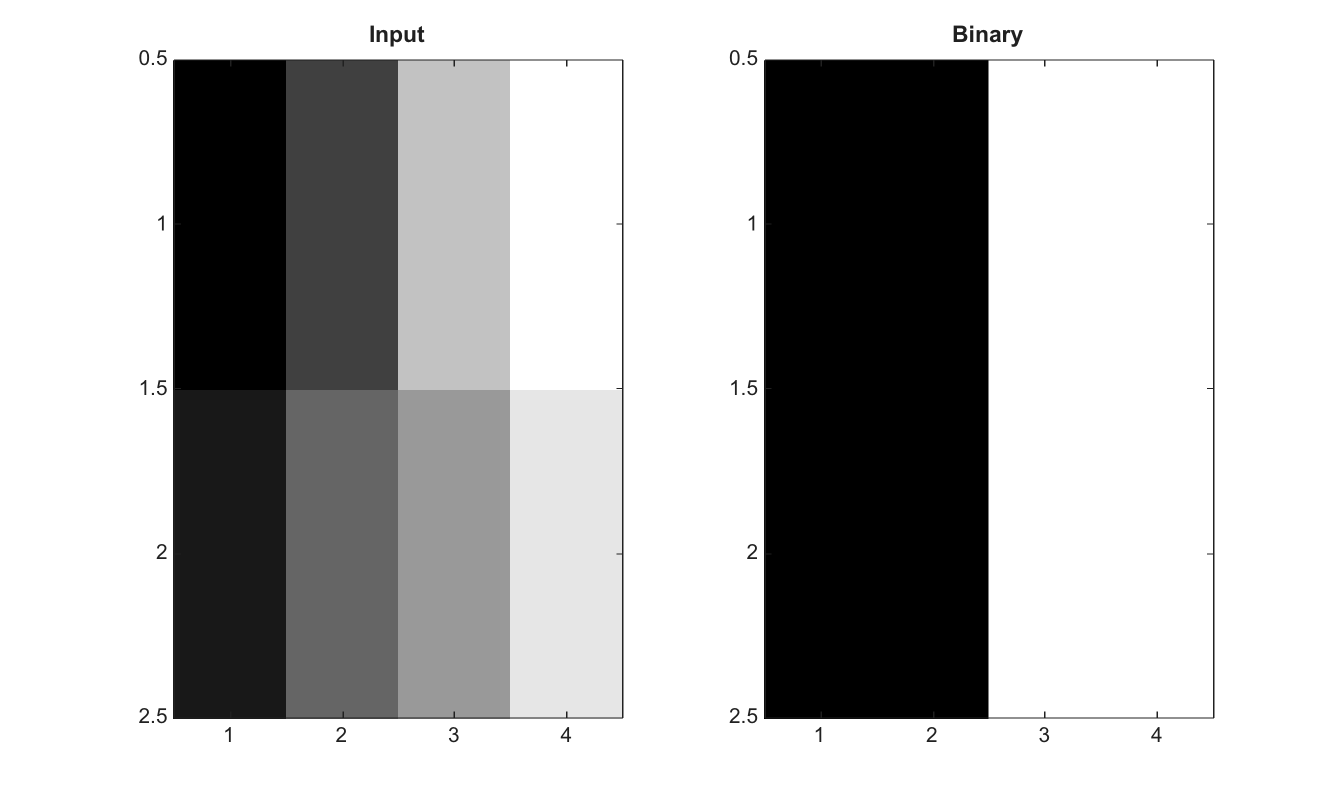
Example illustration
Binarize using an adaptive threshold
I=[0.1 0.1 0.1; 0.1 0.9 0.1; 0.1 0.1 0.1];
BW=imbinarize(I,'adaptive','Sensitivity',0.4)
🔗See Also
graythreshadaptthreshimcomplement
🕔Version History
Version Description
2.0.0 initial version
Edit this page on GitHub