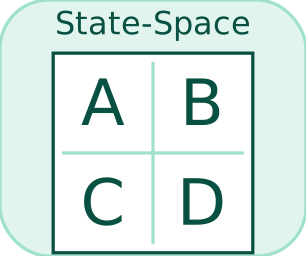
Block type: stateSpace
| Parameter | Description |
|---|---|
| input ports | 1 input port(s) declared. |
| Parameter | Description |
|---|---|
| output ports | 1 output port(s) declared. |
Implements a scalar continuous state-space model.
| Module |
nflow_blocks
|
| Library | Continuous blocks |
| Type |
stateSpace
|
| Label | State-Space |
Description
Continuous-time state-space block defined by matrices A, B, C, D. Represents linear state-space dynamics.
Ports
Input(s)
| Port | Role | Side | Position |
|---|---|---|---|
| Port_1 | Numeric signal read by the block. | left | x=0, y=40 |
Output(s)
| Port | Role | Side | Position |
|---|---|---|---|
| Port_1 | Numeric signal produced by the block. | right | x=160, y=40 |
Parameters
| Parameter | Default value |
|---|---|
A
|
1 |
B
|
1 |
C
|
1 |
D
|
0 |
Inspector Keys
These serialized keys are exposed by the block inspector.
A
B
C
D
Block Characteristics
| Block type | stateSpace |
| Family | Continuous blocks |
| Rendered size | 160 x 80 |
| Phases | INIT, OUTPUT, UPDATE |
| Direct feedthrough | see Algorithms |
| Internal state or history | yes |
| Signal data type | double numeric values |
Algorithms
Equation or Rule
$$\frac{dx}{dt} = A x + B u,\quad y = C x + D u$$Extended Capabilities
This page describes the native runtime behavior observed in the module C++ sources. Declared phases indicate when the simulation engine calls the block.
Code generation: supported for C and Rust.
Implementation Sources
modules/nflow_blocks/libraries/continuous/library.json{
"id": "builtin.continuous",
"title": "Continuous",
"version": "1.0.0",
"format": "nflow-2",
"metadata": {
"author": "Allan CORNET",
"created": "2026-03-21",
"tool": "Nelson nflow"
},
"comment": "Blocks for continuous-time systems",
"license": "LGPL-3.0",
"builtin": true,
"blocks": [
{
"type": "integrator",
"label": "Integrator",
"icon": "integrator.svg",
"phases": [
"INIT",
"OUTPUT",
"UPDATE"
],
"width": 80,
"height": 80,
"inputs": [
{
"x": 0,
"y": 40,
"side": "left"
}
],
"outputs": [
{
"x": 80,
"y": 40,
"side": "right"
}
],
"defaultParams": {
"InitialCondition": 0,
"ExternalReset": "none",
"InitialConditionSource": "internal",
"LowerSaturationLimit": "-inf",
"UpperSaturationLimit": "inf"
},
"render": {
"type": "math",
"useRectElement": true,
"bodyClass": "block-body integrator-body",
"mathGroupClass": "integrator-math",
"formula": "\\frac{1}{s}"
}
},
{
"type": "tf",
"label": "Transfer Fn",
"icon": "tf.svg",
"phases": [
"INIT",
"OUTPUT",
"ALGEBRAIC",
"UPDATE"
],
"width": 85,
"height": 80,
"inputs": [
{
"x": 0,
"y": 40,
"side": "left"
}
],
"outputs": [
{
"x": 85,
"y": 40,
"side": "right"
}
],
"defaultParams": {
"Numerator": [
3
],
"Denominator": [
1,
3
]
},
"render": {
"type": "math",
"bodyClass": "block-body",
"mathGroupClass": "tf-math",
"formula": "\\frac{N(s)}{D(s)}"
}
},
{
"type": "delay",
"label": "Delay",
"icon": "delay.svg",
"phases": [
"INIT",
"OUTPUT",
"UPDATE"
],
"width": 80,
"height": 80,
"inputs": [
{
"x": 0,
"y": 40,
"side": "left"
}
],
"outputs": [
{
"x": 80,
"y": 40,
"side": "right"
}
],
"defaultParams": {
"DelayTime": 0.1
},
"render": {
"type": "math",
"bodyClass": "block-body",
"mathGroupClass": "delay-math",
"formula": "e^{-sT}"
}
},
{
"type": "stateSpace",
"label": "State-Space",
"icon": "stateSpace.svg",
"phases": [
"INIT",
"OUTPUT",
"UPDATE"
],
"width": 160,
"height": 80,
"inputs": [
{
"x": 0,
"y": 40,
"side": "left"
}
],
"outputs": [
{
"x": 160,
"y": 40,
"side": "right"
}
],
"defaultParams": {
"A": 1,
"B": 1,
"C": 1,
"D": 0,
"InitialCondition": 0
},
"render": {
"type": "math",
"bodyClass": "block-body",
"mathGroupClass": "state-space-math",
"formula": "\\dot{x}=Ax+Bu",
"textSize": "16px"
}
},
{
"type": "lpf",
"label": "LPF",
"icon": "lpf.svg",
"phases": [
"INIT",
"OUTPUT",
"UPDATE"
],
"width": 80,
"height": 80,
"inputs": [
{
"x": 0,
"y": 40,
"side": "left"
}
],
"outputs": [
{
"x": 80,
"y": 40,
"side": "right"
}
],
"defaultParams": {
"Cutoff": 1
},
"render": {
"src": "lpf.svg",
"type": "image"
}
},
{
"type": "hpf",
"label": "HPF",
"icon": "hpf.svg",
"phases": [
"INIT",
"OUTPUT",
"UPDATE"
],
"width": 80,
"height": 80,
"inputs": [
{
"x": 0,
"y": 40,
"side": "left"
}
],
"outputs": [
{
"x": 80,
"y": 40,
"side": "right"
}
],
"defaultParams": {
"Cutoff": 1
},
"render": {
"src": "hpf.svg",
"type": "image"
}
},
{
"type": "derivative",
"label": "Derivative",
"icon": "derivative.svg",
"phases": [
"INIT",
"OUTPUT",
"UPDATE"
],
"width": 80,
"height": 80,
"inputs": [
{
"x": 0,
"y": 40,
"side": "left"
}
],
"outputs": [
{
"x": 80,
"y": 40,
"side": "right"
}
],
"defaultParams": {},
"render": {
"type": "math",
"useRectElement": true,
"bodyClass": "block-body",
"mathGroupClass": "derivative-math",
"formula": "\\frac{d}{dt}"
}
},
{
"type": "pid",
"label": "PID",
"icon": "pid.svg",
"phases": [
"INIT",
"OUTPUT",
"UPDATE"
],
"width": 80,
"height": 80,
"inputs": [
{
"x": 0,
"y": 40,
"side": "left"
}
],
"outputs": [
{
"x": 80,
"y": 40,
"side": "right"
}
],
"defaultParams": {
"P": 1,
"I": 0,
"D": 0,
"N": 0,
"LowerSaturationLimit": "-inf",
"UpperSaturationLimit": "inf"
},
"render": {
"type": "math",
"bodyClass": "block-body",
"mathGroupClass": "pid-math",
"formula": "\\mathsf{PID}"
}
},
{
"type": "constraint",
"label": "Constraint",
"icon": "constraint.svg",
"phases": [
"INIT",
"OUTPUT",
"DERIVATIVE"
],
"width": 80,
"height": 80,
"inputs": [
{
"x": 0,
"y": 40,
"side": "left"
}
],
"outputs": [
{
"x": 80,
"y": 40,
"side": "right"
}
],
"defaultParams": {
"InitialCondition": 0
},
"render": {
"type": "math",
"bodyClass": "block-body",
"mathGroupClass": "constraint-math",
"formula": "g=0"
}
}
]
}
modules/nflow_blocks/src/cpp/continuous/stateSpace.cpp//=============================================================================
// Copyright (c) 2016-present Allan CORNET (Nelson)
//=============================================================================
// This file is part of Nelson.
//=============================================================================
// LICENCE_BLOCK_BEGIN
// SPDX-License-Identifier: LGPL-3.0-or-later
// LICENCE_BLOCK_END
//=============================================================================
#include "SimEngineTypes.hpp"
#include "BlockRegistry.hpp"
#include "FieldNames.hpp"
#include "NFlowBlockDescriptor.hpp"
#include <cmath>
#include <algorithm>
#include <string>
#include <vector>
#include "continuous_blocks.hpp"
//=============================================================================
namespace Nelson {
namespace NFlow {
//=============================================================================
// Resolved MIMO state-space matrices (row-major) with their dimensions.
// A is nx x nx, B is nx x nu, C is ny x nx, D is ny x nu. A scalar param
// (SISO) yields nx = nu = ny = 1, identical to the historical behavior.
struct SsMatrices
{
int nx = 1, nu = 1, ny = 1;
std::vector<double> A, B, C, D; // row-major
};
//=============================================================================
int
stateSpaceStateCount(const Block& b, const ValMap& vars)
{
nflow::BlockDescriptor bd(b, vars);
std::vector<double> a = bd.paramList(nflow::kA);
if (a.empty()) {
return 1;
}
// A is square nx x nx (row-major flat list).
const int nx = (int)std::llround(std::sqrt((double)a.size()));
return std::max(1, nx);
}
//=============================================================================
// Output width (ny) for the dimension-propagation pass: ny = rows(C) =
// len(C) / nx.
int
stateSpaceOutputWidth(const Block& b, const ValMap& vars)
{
nflow::BlockDescriptor bd(b, vars);
const int nx = stateSpaceStateCount(b, vars);
std::vector<double> c = bd.paramList(nflow::kC);
if (c.empty() || nx <= 0) {
return 1;
}
return std::max(1, (int)c.size() / nx);
}
//=============================================================================
// Initial continuous state. A scalar broadcasts over the nx states, a list
// gives them one by one, and an absent parameter keeps the historical all
// zeros. Without it a state space could only ever start at the origin, so a
// diagram that starts one away from it - an observer seeded off the plant,
// say - had no way to say so.
static std::vector<double>
ssInitialState(const nflow::BlockDescriptor& bd, int nx)
{
std::vector<double> out((size_t)std::max(0, nx), 0.0);
const std::vector<double> x0 = bd.paramList(nflow::kInitial);
if (x0.empty()) {
return out;
}
for (int i = 0; i < nx; ++i) {
out[(size_t)i] = (i < (int)x0.size()) ? x0[(size_t)i] : x0.back();
}
return out;
}
//=============================================================================
static SsMatrices
buildSs(const Block& b, const ValMap& vars, int nu)
{
nflow::BlockDescriptor bd(b, vars);
SsMatrices m;
m.A = bd.paramList(nflow::kA);
m.B = bd.paramList(nflow::kB);
m.C = bd.paramList(nflow::kC);
m.D = bd.paramList(nflow::kD);
if (m.A.empty()) {
m.A = { 0.0 };
}
m.nx = std::max(1, (int)std::llround(std::sqrt((double)m.A.size())));
m.nu = std::max(1, nu);
m.ny = m.C.empty() ? 1 : std::max(1, (int)m.C.size() / m.nx);
// Pad missing matrices with zeros so index math never overruns.
m.A.resize((size_t)m.nx * m.nx, 0.0);
m.B.resize((size_t)m.nx * m.nu, 0.0);
m.C.resize((size_t)m.ny * m.nx, 0.0);
m.D.resize((size_t)m.ny * m.nu, 0.0);
return m;
}
//=============================================================================
// y = C*x + D*u (row-major matrices, x length nx, u length nu).
static void
ssOutput(const SsMatrices& m, const double* x, const SigView& u, double* y)
{
for (int i = 0; i < m.ny; ++i) {
double acc = 0.0;
for (int j = 0; j < m.nx; ++j) {
acc += m.C[(size_t)i * m.nx + j] * x[j];
}
for (int j = 0; j < m.nu; ++j) {
acc += m.D[(size_t)i * m.nu + j] * sigAt(u, j);
}
y[i] = acc;
}
}
//=============================================================================
// y = C*x + D*u with u from a raw latch (nullptr = zeros). Fixed-step
// OUTPUT runs before the algebraic wave recomputes this step's sources,
// so the D feedthrough reads the PREVIOUS step's inputs latched by UPDATE.
static void
ssOutputU(const SsMatrices& m, const double* x, const double* u, double* y)
{
for (int i = 0; i < m.ny; ++i) {
double acc = 0.0;
for (int j = 0; j < m.nx; ++j) {
acc += m.C[(size_t)i * m.nx + j] * x[j];
}
for (int j = 0; j < m.nu; ++j) {
acc += m.D[(size_t)i * m.nu + j] * (u ? u[j] : 0.0);
}
y[i] = acc;
}
}
//=============================================================================
// xdot = A*x + B*u.
static void
ssDeriv(const SsMatrices& m, const double* x, const SigView& u, double* xdot)
{
for (int i = 0; i < m.nx; ++i) {
double acc = 0.0;
for (int j = 0; j < m.nx; ++j) {
acc += m.A[(size_t)i * m.nx + j] * x[j];
}
for (int j = 0; j < m.nu; ++j) {
acc += m.B[(size_t)i * m.nu + j] * sigAt(u, j);
}
xdot[i] = acc;
}
}
//=============================================================================
} // namespace NFlow
} // namespace Nelson
//=============================================================================
bool
Nelson::NFlow::handleStateSpace(SimCtx& ctx, const Block& b, Phase phase)
{
auto& st = getState(ctx, b.nid);
const int nu = numInputs(ctx, b.nid) > 0 ? b.inWidth(0) : 1;
SsMatrices m = buildSs(b, ctx.variables, nu);
if (phase == Phase::INIT) {
// x in [0, nx), then the input latch in [nx, nx+nu); the continuous
// seeding only reads the first xLength (= nx) entries.
st.vec.assign((size_t)m.nx + m.nu, 0.0);
const std::vector<double> x0
= ssInitialState(nflow::BlockDescriptor(b, ctx.variables), m.nx);
for (int i = 0; i < m.nx && i < (int)x0.size(); ++i) {
st.vec[(size_t)i] = x0[(size_t)i];
}
st.scalar = 0.0;
st.output = 0.0;
return false;
}
if (phase == Phase::OUTPUT) {
SigView u = getInputSig(ctx, b.nid, 0);
double* xs = blockX(ctx, b.nid);
std::vector<double> y(m.ny, 0.0);
if (xs) {
// Variable-step minor step: y = C*x + D*u from the scattered state.
ssOutput(m, xs, u, y.data());
} else if ((int)st.vec.size() >= m.nx) {
// Fixed-step path: latched state, and D reads the previous step's
// latched inputs (this phase runs before the algebraic wave, so
// the live input slots still hold this step's reset values).
const double* ulat
= ((int)st.vec.size() >= m.nx + m.nu) ? (st.vec.data() + m.nx) : nullptr;
ssOutputU(m, st.vec.data(), ulat, y.data());
}
double* out = outputSlice(ctx, b.nid, 0);
// Clamp to the resolved port width (defensive: a hand-written diagram
// declaring extra output ports must not overrun the port-0 buffer).
const int wlim = std::min(m.ny, std::max(1, b.outWidth(0)));
for (int i = 0; i < wlim; ++i) {
out[i] = y[i];
}
return false;
}
if (phase == Phase::ALGEBRAIC) {
// Direct feedthrough (D != 0): re-emit y = C*x + D*u with the CURRENT
// inputs so downstream algebraic consumers see the live D term (the
// OUTPUT phase ran before this step's sources settled; a D != 0 loop
// becomes a real algebraic cycle the Gauss-Seidel pass relaxes).
// No-op when D is all zero; the historical scheduling stays intact.
bool anyD = false;
for (double v : m.D) {
if (v != 0.0) {
anyD = true;
break;
}
}
if (!anyD) {
return false;
}
SigView u = getInputSig(ctx, b.nid, 0);
double* xs = blockX(ctx, b.nid);
const double* x
= xs != nullptr ? xs : (((int)st.vec.size() >= m.nx) ? st.vec.data() : nullptr);
if (x == nullptr) {
return false;
}
std::vector<double> y(m.ny, 0.0);
ssOutput(m, x, u, y.data());
double* out = outputSlice(ctx, b.nid, 0);
const int wlim = std::min(m.ny, std::max(1, b.outWidth(0)));
bool changed = false;
for (int i = 0; i < wlim; ++i) {
if (out[i] != y[i]) {
out[i] = y[i];
changed = true;
}
}
return changed;
}
if (phase == Phase::UPDATE) {
// Fixed-step Euler on the state (current inputs), then latch u for
// the next step's OUTPUT feedthrough.
if ((int)st.vec.size() < m.nx + m.nu) {
st.vec.resize((size_t)m.nx + m.nu, 0.0);
}
SigView u = getInputSig(ctx, b.nid, 0);
std::vector<double> xdot(m.nx, 0.0);
ssDeriv(m, st.vec.data(), u, xdot.data());
for (int i = 0; i < m.nx; ++i) {
st.vec[i] += ctx.dt * xdot[i];
}
for (int j = 0; j < m.nu; ++j) {
st.vec[(size_t)m.nx + j] = sigAt(u, j);
}
return false;
}
if (phase == Phase::DERIVATIVE) {
double* xdot = blockXdot(ctx, b.nid);
if (xdot) {
double* xs = blockX(ctx, b.nid);
const double* x = xs ? xs : st.vec.data();
SigView u = getInputSig(ctx, b.nid, 0);
ssDeriv(m, x, u, xdot);
}
return false;
}
return false;
}
//=============================================================================
namespace Nelson {
namespace NFlow {
namespace {
// Resolved matrices for the code generator (row-major, zero-padded):
// nu = wired scalar input ports (the vector expansion turns the nu-wide
// input wire into nu scalar ports, mirroring the runtime's wired-width
// rule), ny = rows of C. A multi-STATE scalar-I/O system (nx>1,
// nu=ny=1, what a reduced linear island yields) and a true MIMO both
// join the RK4 seam; a MIMO emits one output variable per row
// (out_<id>, out_<id>_p1, ...).
struct SsCg
{
int nx = 1, nu = 1, ny = 1;
std::vector<double> A, B, C, D;
};
static SsCg
buildSsCg(const BlockCodegenArgs& a)
{
nflow::BlockDescriptor bd(*a.block, *a.variables);
SsCg s;
s.A = bd.paramList(nflow::kA);
s.B = bd.paramList(nflow::kB);
s.C = bd.paramList(nflow::kC);
s.D = bd.paramList(nflow::kD);
s.nx = s.A.empty() ? 1 : (int)std::llround(std::sqrt((double)s.A.size()));
if (s.nx < 1) {
s.nx = 1;
}
// Declared port count (the expansion declares one scalar port per
// input element); a declared-but-unwired trailing port still
// counts, its expression falls back to 0.0.
int declIn = 0;
if (a.block && a.block->contains(nflow::kInputs)
&& (*a.block)[nflow::kInputs].is_number()) {
declIn = (*a.block)[nflow::kInputs].get<int>();
}
s.nu = std::max(1, std::max(declIn, (int)a.inputIds.size()));
s.ny = s.C.empty() ? 1 : std::max(1, (int)s.C.size() / s.nx);
s.A.resize((size_t)s.nx * s.nx, 0.0);
s.B.resize((size_t)s.nx * s.nu, 0.0);
s.C.resize((size_t)s.ny * s.nx, 0.0);
s.D.resize((size_t)s.ny * s.nu, 0.0);
return s;
}
// State field name: SISO keeps the historical single field so its
// generated code stays byte-identical; nx>1 uses per-state fields.
static std::string
ssName(const std::string& id, int i, int nx, const std::string& pfx)
{
return nx == 1 ? (pfx + "ss_x_" + id) : (pfx + "ss_x_" + id + "_" + std::to_string(i));
}
// Output variable of row r (port r): out_<id>, then out_<id>_p<r>.
static std::string
ssOutName(const std::string& id, int r)
{
return r > 0 ? ("out_" + id + "_p" + std::to_string(r)) : ("out_" + id);
}
// Current input expression of column k ("0.0" for a declared but
// unwired trailing port beyond the generator's expression list).
static std::string
ssUin(const BlockCodegenArgs& a, int k)
{
return ((size_t)k < a.in.size()) ? a.in[(size_t)k] : std::string("0.0");
}
// Latched-input state field of column k (MIMO fixed-step outputs).
static std::string
ssUlatch(const std::string& id, int k, const std::string& pfx)
{
return pfx + "ss_u_" + id + "_" + std::to_string(k);
}
// True when any D entry is nonzero: the runtime then re-emits the
// output during ALGEBRAIC with the CURRENT inputs (real feedthrough),
// so the generated output must read the current expressions too.
static bool
ssAnyD(const SsCg& s)
{
for (double v : s.D) {
if (v != 0.0) {
return true;
}
}
return false;
}
// Row r of y = C*x + D*u (all terms, so nx>1 is never empty); `u`
// supplies the per-column input expression (current or latched).
static std::string
ssOutputExpr(const BlockCodegenArgs& a, const SsCg& s, int r, const std::string& pfx,
const std::function<std::string(int)>& u)
{
std::string e;
for (int j = 0; j < s.nx; ++j) {
e += (j ? " + " : "") + a.fmt(s.C[(size_t)r * s.nx + j]) + " * "
+ ssName(a.id, j, s.nx, pfx);
}
for (int k = 0; k < s.nu; ++k) {
e += " + " + a.fmt(s.D[(size_t)r * s.nu + k]) + " * " + u(k);
}
return e;
}
// xdot_i = A row i * x + B row i * u (current inputs).
static std::string
ssDerivExpr(const BlockCodegenArgs& a, const SsCg& s, int i, const std::string& pfx)
{
std::string e;
for (int j = 0; j < s.nx; ++j) {
e += (j ? " + " : "") + a.fmt(s.A[(size_t)i * s.nx + j]) + " * "
+ ssName(a.id, j, s.nx, pfx);
}
for (int k = 0; k < s.nu; ++k) {
e += " + " + a.fmt(s.B[(size_t)i * s.nu + k]) + " * " + ssUin(a, k);
}
return e;
}
} // namespace
} // namespace NFlow
} // namespace Nelson
//=============================================================================
Nelson::NFlow::BlockCodegenTemplate
Nelson::NFlow::getCodeGenCStateSpace()
{
BlockCodegenTemplate t;
t.emitState = [](const BlockCodegenStateArgs& a) {
nflow::BlockDescriptor bd(*a.block, *a.variables);
std::vector<double> A = bd.paramList(nflow::kA);
int nx = A.empty() ? 1 : (int)std::llround(std::sqrt((double)A.size()));
// Seed the emitted state from InitialCondition, as INIT does, so the
// generated program starts where the simulation starts.
const std::vector<double> x0 = ssInitialState(bd, nx);
if (nx <= 1) {
a.addState("ss_x_" + a.id, x0.empty() ? "" : a.fmt(x0[0]), "");
} else {
for (int i = 0; i < nx; ++i) {
a.addState("ss_x_" + a.id + "_" + std::to_string(i),
(i < (int)x0.size()) ? a.fmt(x0[(size_t)i]) : "", "");
}
}
// Fixed-step outputs read the LATCHED previous-step inputs (the
// runtime emits OUTPUT before the algebraic wave recomputes sources),
// for every form, SISO included.
const int nu = std::max(1,
(a.block->contains(nflow::kInputs) && (*a.block)[nflow::kInputs].is_number())
? (*a.block)[nflow::kInputs].get<int>()
: 1);
// Latch fields only when D is all zero: a live D reads the current
// input expressions instead (runtime ALGEBRAIC re-run), so the
// latches would be dead weight.
std::vector<double> Dv = bd.paramList(nflow::kD);
bool anyDv = false;
for (double v : Dv) {
if (v != 0.0) {
anyDv = true;
break;
}
}
for (int k = 0; !anyDv && k < nu; ++k) {
a.addState("ss_u_" + a.id + "_" + std::to_string(k), "", "");
}
};
t.emitStep = [](const BlockCodegenArgs& a) {
SsCg s = buildSsCg(a);
// Forward Euler, runtime parity for every form: report every output
// row at the PRE-step state, then advance with the current inputs.
// The D term reads the CURRENT inputs when D != 0 (the runtime
// re-emits during ALGEBRAIC, real feedthrough) and the latched
// previous-step inputs otherwise (OUTPUT-before-ALGEBRAIC parity).
const bool liveD = ssAnyD(s);
auto uOut = [&](int k) { return liveD ? ssUin(a, k) : ssUlatch(a.id, k, "s->"); };
for (int r = 0; r < s.ny; ++r) {
a.line(ssOutName(a.id, r) + " = " + ssOutputExpr(a, s, r, "s->", uOut) + ";");
}
for (int i = 0; i < s.nx; ++i) {
a.line("double __ssd_" + a.id + "_" + std::to_string(i) + " = "
+ ssDerivExpr(a, s, i, "s->") + ";");
}
for (int i = 0; i < s.nx; ++i) {
a.line(ssName(a.id, i, s.nx, "s->") + " += dt * __ssd_" + a.id + "_" + std::to_string(i)
+ ";");
}
if (!liveD) {
for (int k = 0; k < s.nu; ++k) {
a.line(ssUlatch(a.id, k, "s->") + " = " + ssUin(a, k) + ";");
}
}
};
// Unified variable-step codegen: nx scalar continuous states (MIMO included).
t.continuousWidth = [](const BlockCodegenArgs& a) -> int { return buildSsCg(a).nx; };
// x' = A*x + B*u, y = C*x + D*u over the scattered state(s).
t.emitRk4 = [](const BlockCodegenArgs& a) {
SsCg s = buildSsCg(a);
switch (a.rk4Op) {
case Rk4Gather:
for (int i = 0; i < s.nx; ++i) {
a.line(a.rk4Arr + "[" + std::to_string(a.stateOffset + i)
+ "] = " + ssName(a.id, i, s.nx, "s->") + ";");
}
break;
case Rk4Scatter:
for (int i = 0; i < s.nx; ++i) {
a.line(ssName(a.id, i, s.nx, "s->") + " = " + a.rk4Arr + "["
+ std::to_string(a.stateOffset + i) + "];");
}
break;
case Rk4Output:
// D != 0: the runtime's per-stage ALGEBRAIC re-run delivers the
// CURRENT stage inputs to the D term; read the live expressions.
// D == 0: the latch fields (never written on the RK4 path) stay
// 0.0, reproducing the zeroed-slot OUTPUT exactly (and the D term
// is zero anyway).
{
const bool liveD = ssAnyD(s);
for (int r = 0; r < s.ny; ++r) {
a.line(ssOutName(a.id, r) + " = " + ssOutputExpr(a, s, r, "s->", [&](int k) {
return liveD ? ssUin(a, k) : ssUlatch(a.id, k, "s->");
}) + ";");
}
}
break;
case Rk4Deriv:
for (int i = 0; i < s.nx; ++i) {
a.line(a.rk4Arr + "[" + std::to_string(a.stateOffset + i)
+ "] = " + ssDerivExpr(a, s, i, "s->") + ";");
}
break;
default:
break;
}
};
return t;
}
//=============================================================================
Nelson::NFlow::BlockCodegenTemplate
Nelson::NFlow::getCodeGenRustStateSpace()
{
BlockCodegenTemplate t;
t.emitState = [](const BlockCodegenStateArgs& a) {
nflow::BlockDescriptor bd(*a.block, *a.variables);
std::vector<double> A = bd.paramList(nflow::kA);
int nx = A.empty() ? 1 : (int)std::llround(std::sqrt((double)A.size()));
// Seed the emitted state from InitialCondition, as INIT does, so the
// generated program starts where the simulation starts.
const std::vector<double> x0 = ssInitialState(bd, nx);
if (nx <= 1) {
a.addState("ss_x_" + a.id, x0.empty() ? "" : a.fmt(x0[0]), "");
} else {
for (int i = 0; i < nx; ++i) {
a.addState("ss_x_" + a.id + "_" + std::to_string(i),
(i < (int)x0.size()) ? a.fmt(x0[(size_t)i]) : "", "");
}
}
const int nu = std::max(1,
(a.block->contains(nflow::kInputs) && (*a.block)[nflow::kInputs].is_number())
? (*a.block)[nflow::kInputs].get<int>()
: 1);
// Latch fields only when D is all zero: a live D reads the current
// input expressions instead (runtime ALGEBRAIC re-run), so the
// latches would be dead weight.
std::vector<double> Dv = bd.paramList(nflow::kD);
bool anyDv = false;
for (double v : Dv) {
if (v != 0.0) {
anyDv = true;
break;
}
}
for (int k = 0; !anyDv && k < nu; ++k) {
a.addState("ss_u_" + a.id + "_" + std::to_string(k), "", "");
}
};
t.emitStep = [](const BlockCodegenArgs& a) {
SsCg s = buildSsCg(a);
const bool liveD = ssAnyD(s);
auto uOut = [&](int k) { return liveD ? ssUin(a, k) : ssUlatch(a.id, k, "s."); };
for (int r = 0; r < s.ny; ++r) {
a.line(ssOutName(a.id, r) + " = " + ssOutputExpr(a, s, r, "s.", uOut) + ";");
}
for (int i = 0; i < s.nx; ++i) {
a.line("let __ssd_" + a.id + "_" + std::to_string(i) + " = "
+ ssDerivExpr(a, s, i, "s.") + ";");
}
for (int i = 0; i < s.nx; ++i) {
a.line(ssName(a.id, i, s.nx, "s.") + " += dt * __ssd_" + a.id + "_" + std::to_string(i)
+ ";");
}
if (!liveD) {
for (int k = 0; k < s.nu; ++k) {
a.line(ssUlatch(a.id, k, "s.") + " = " + ssUin(a, k) + ";");
}
}
};
t.continuousWidth = [](const BlockCodegenArgs& a) -> int { return buildSsCg(a).nx; };
t.emitRk4 = [](const BlockCodegenArgs& a) {
SsCg s = buildSsCg(a);
switch (a.rk4Op) {
case Rk4Gather:
for (int i = 0; i < s.nx; ++i) {
a.line(a.rk4Arr + "[" + std::to_string(a.stateOffset + i)
+ "] = " + ssName(a.id, i, s.nx, "s.") + ";");
}
break;
case Rk4Scatter:
for (int i = 0; i < s.nx; ++i) {
a.line(ssName(a.id, i, s.nx, "s.") + " = " + a.rk4Arr + "["
+ std::to_string(a.stateOffset + i) + "];");
}
break;
case Rk4Output:
// See the C emitter: live inputs when D != 0 (per-stage ALGEBRAIC
// re-run), never-written latch fields (0.0) otherwise.
{
const bool liveD = ssAnyD(s);
for (int r = 0; r < s.ny; ++r) {
a.line(ssOutName(a.id, r) + " = " + ssOutputExpr(a, s, r, "s.", [&](int k) {
return liveD ? ssUin(a, k) : ssUlatch(a.id, k, "s.");
}) + ";");
}
}
break;
case Rk4Deriv:
for (int i = 0; i < s.nx; ++i) {
a.line(a.rk4Arr + "[" + std::to_string(a.stateOffset + i)
+ "] = " + ssDerivExpr(a, s, i, "s.") + ";");
}
break;
default:
break;
}
};
return t;
}
//=============================================================================
| Version | Description |
|---|---|
| 1.0.0 | initial version |