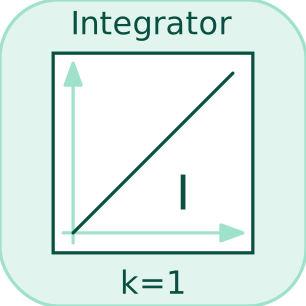
Block type: integrator
| Parameter | Description |
|---|---|
| input ports | 1 input port(s) declared. |
| Parameter | Description |
|---|---|
| output ports | 1 output port(s) declared. |
Integrates the input over time with optional clamps.
| Module |
nflow_blocks
|
| Library | Continuous blocks |
| Type |
integrator
|
| Label | Integrator |
Description
The Integrator block integrates its input over time. It maintains internal state and produces the integrated output.
Ports
Input(s)
| Port | Role | Side | Position |
|---|---|---|---|
| Port_1 | Numeric signal read by the block. | left | x=0, y=40 |
Output(s)
| Port | Role | Side | Position |
|---|---|---|---|
| Port_1 | Numeric signal produced by the block. | right | x=80, y=40 |
Parameters
| Parameter | Default value |
|---|---|
initial
|
0 |
min
|
-inf |
max
|
inf |
Inspector Keys
These serialized keys are exposed by the block inspector.
initial
min
max
Block Characteristics
| Block type | integrator |
| Family | Continuous blocks |
| Rendered size | 80 x 80 |
| Phases | INIT, OUTPUT, UPDATE |
| Direct feedthrough | see Algorithms |
| Internal state or history | yes |
| Signal data type | double numeric values |
Algorithms
Equation or Rule
$$x_{k+1} = \operatorname{clamp}(x_k + dt\,u_k,\,min,\,max),\quad y = x$$Extended Capabilities
This page describes the native runtime behavior observed in the module C++ sources. Declared phases indicate when the simulation engine calls the block.
Code generation: supported for C and Rust.
Implementation Sources
modules/nflow_blocks/libraries/continuous/library.json{
"id": "builtin.continuous",
"title": "Continuous",
"version": "1.0.0",
"format": "nflow-2",
"metadata": {
"author": "Allan CORNET",
"created": "2026-03-21",
"tool": "Nelson nflow"
},
"comment": "Blocks for continuous-time systems",
"license": "LGPL-3.0",
"builtin": true,
"blocks": [
{
"type": "integrator",
"label": "Integrator",
"icon": "integrator.svg",
"phases": [
"INIT",
"OUTPUT",
"UPDATE"
],
"width": 80,
"height": 80,
"inputs": [
{
"x": 0,
"y": 40,
"side": "left"
}
],
"outputs": [
{
"x": 80,
"y": 40,
"side": "right"
}
],
"defaultParams": {
"InitialCondition": 0,
"ExternalReset": "none",
"InitialConditionSource": "internal",
"LowerSaturationLimit": "-inf",
"UpperSaturationLimit": "inf"
},
"render": {
"type": "math",
"useRectElement": true,
"bodyClass": "block-body integrator-body",
"mathGroupClass": "integrator-math",
"formula": "\\frac{1}{s}"
}
},
{
"type": "tf",
"label": "Transfer Fn",
"icon": "tf.svg",
"phases": [
"INIT",
"OUTPUT",
"ALGEBRAIC",
"UPDATE"
],
"width": 85,
"height": 80,
"inputs": [
{
"x": 0,
"y": 40,
"side": "left"
}
],
"outputs": [
{
"x": 85,
"y": 40,
"side": "right"
}
],
"defaultParams": {
"Numerator": [
3
],
"Denominator": [
1,
3
]
},
"render": {
"type": "math",
"bodyClass": "block-body",
"mathGroupClass": "tf-math",
"formula": "\\frac{N(s)}{D(s)}"
}
},
{
"type": "delay",
"label": "Delay",
"icon": "delay.svg",
"phases": [
"INIT",
"OUTPUT",
"UPDATE"
],
"width": 80,
"height": 80,
"inputs": [
{
"x": 0,
"y": 40,
"side": "left"
}
],
"outputs": [
{
"x": 80,
"y": 40,
"side": "right"
}
],
"defaultParams": {
"DelayTime": 0.1
},
"render": {
"type": "math",
"bodyClass": "block-body",
"mathGroupClass": "delay-math",
"formula": "e^{-sT}"
}
},
{
"type": "stateSpace",
"label": "State-Space",
"icon": "stateSpace.svg",
"phases": [
"INIT",
"OUTPUT",
"UPDATE"
],
"width": 160,
"height": 80,
"inputs": [
{
"x": 0,
"y": 40,
"side": "left"
}
],
"outputs": [
{
"x": 160,
"y": 40,
"side": "right"
}
],
"defaultParams": {
"A": 1,
"B": 1,
"C": 1,
"D": 0,
"InitialCondition": 0
},
"render": {
"type": "math",
"bodyClass": "block-body",
"mathGroupClass": "state-space-math",
"formula": "\\dot{x}=Ax+Bu",
"textSize": "16px"
}
},
{
"type": "lpf",
"label": "LPF",
"icon": "lpf.svg",
"phases": [
"INIT",
"OUTPUT",
"UPDATE"
],
"width": 80,
"height": 80,
"inputs": [
{
"x": 0,
"y": 40,
"side": "left"
}
],
"outputs": [
{
"x": 80,
"y": 40,
"side": "right"
}
],
"defaultParams": {
"Cutoff": 1
},
"render": {
"src": "lpf.svg",
"type": "image"
}
},
{
"type": "hpf",
"label": "HPF",
"icon": "hpf.svg",
"phases": [
"INIT",
"OUTPUT",
"UPDATE"
],
"width": 80,
"height": 80,
"inputs": [
{
"x": 0,
"y": 40,
"side": "left"
}
],
"outputs": [
{
"x": 80,
"y": 40,
"side": "right"
}
],
"defaultParams": {
"Cutoff": 1
},
"render": {
"src": "hpf.svg",
"type": "image"
}
},
{
"type": "derivative",
"label": "Derivative",
"icon": "derivative.svg",
"phases": [
"INIT",
"OUTPUT",
"UPDATE"
],
"width": 80,
"height": 80,
"inputs": [
{
"x": 0,
"y": 40,
"side": "left"
}
],
"outputs": [
{
"x": 80,
"y": 40,
"side": "right"
}
],
"defaultParams": {},
"render": {
"type": "math",
"useRectElement": true,
"bodyClass": "block-body",
"mathGroupClass": "derivative-math",
"formula": "\\frac{d}{dt}"
}
},
{
"type": "pid",
"label": "PID",
"icon": "pid.svg",
"phases": [
"INIT",
"OUTPUT",
"UPDATE"
],
"width": 80,
"height": 80,
"inputs": [
{
"x": 0,
"y": 40,
"side": "left"
}
],
"outputs": [
{
"x": 80,
"y": 40,
"side": "right"
}
],
"defaultParams": {
"P": 1,
"I": 0,
"D": 0,
"N": 0,
"LowerSaturationLimit": "-inf",
"UpperSaturationLimit": "inf"
},
"render": {
"type": "math",
"bodyClass": "block-body",
"mathGroupClass": "pid-math",
"formula": "\\mathsf{PID}"
}
},
{
"type": "constraint",
"label": "Constraint",
"icon": "constraint.svg",
"phases": [
"INIT",
"OUTPUT",
"DERIVATIVE"
],
"width": 80,
"height": 80,
"inputs": [
{
"x": 0,
"y": 40,
"side": "left"
}
],
"outputs": [
{
"x": 80,
"y": 40,
"side": "right"
}
],
"defaultParams": {
"InitialCondition": 0
},
"render": {
"type": "math",
"bodyClass": "block-body",
"mathGroupClass": "constraint-math",
"formula": "g=0"
}
}
]
}
modules/nflow_blocks/src/cpp/continuous/integrator.cpp//=============================================================================
// Copyright (c) 2016-present Allan CORNET (Nelson)
//=============================================================================
// This file is part of Nelson.
//=============================================================================
// LICENCE_BLOCK_BEGIN
// SPDX-License-Identifier: LGPL-3.0-or-later
// LICENCE_BLOCK_END
//=============================================================================
#include "SimEngineTypes.hpp"
#include "BlockRegistry.hpp"
#include "FieldNames.hpp"
#include "NFlowBlockDescriptor.hpp"
#include "EdgeDetect.hpp"
#include <string>
#include <cmath>
#include <algorithm>
#include "continuous_blocks.hpp"
//=============================================================================
static inline double
holdAtLimit(double x, double u, double mn, double mx);
//=============================================================================
bool
Nelson::NFlow::handleIntegrator(SimCtx& ctx, const Block& b, Phase phase)
{
auto& st = getState(ctx, b.nid);
nflow::BlockDescriptor bd(b, ctx.variables);
const int w = outputWidth(ctx, b.nid, 0);
const double mn = bd.paramDouble(nflow::kMin, -std::numeric_limits<double>::infinity());
const double mx = bd.paramDouble(nflow::kMax, std::numeric_limits<double>::infinity());
// External reset and external initial condition. The extra ports follow the
// signal in that order, so port 1 is the reset when there is one and the
// initial condition otherwise. 'level' holds the state at the initial
// condition while the line is non-zero; the edge kinds reset once, on the
// edge, under the shared rule in EdgeDetect.hpp.
const std::string extReset = bd.paramStr("ExternalReset", "none");
const int resetEdge = edgeTypeOf(extReset);
const bool levelReset = (extReset == "level");
const bool hasReset = (resetEdge >= 0) || levelReset;
const bool externalIC = (bd.paramStr("InitialConditionSource", "internal") == "external");
const int resetPort = hasReset ? 1 : -1;
const int icPort = externalIC ? (hasReset ? 2 : 1) : -1;
// The initial condition an element resets to: the wired signal when it is
// external, the parameter otherwise (scalar broadcast or per element).
auto initialOf = [&](int i) -> double {
if (icPort >= 0 && hasInput(ctx, b.nid, icPort)) {
SigView v = getInputSig(ctx, b.nid, icPort);
return sigAt(v, i);
}
if (w <= 1) {
return bd.paramDouble(nflow::kInitial, 0.0);
}
const std::vector<double> list = bd.paramList(nflow::kInitial);
if (list.empty()) {
return 0.0;
}
return (i < (int)list.size()) ? list[i] : list.back();
};
const double resetLine = (hasReset && hasInput(ctx, b.nid, resetPort))
? getInput(ctx, b.nid, resetPort, 0.0)
: 0.0;
const bool holding = levelReset && (resetLine != 0.0);
const bool resetNow = holding
|| (resetEdge >= 0 && st.resetPrimed && edgeFired(st.resetPrev, resetLine, resetEdge));
if (phase == Phase::INIT) {
st.resetPrev = 0.0;
st.resetPrimed = false;
if (w <= 1) {
double ini = bd.paramDouble(nflow::kInitial, 0.0);
st.scalar = clampVal(ini, mn, mx);
} else {
// Vector integrator: Initial may be a scalar (broadcast) or a
// list matching the signal width.
std::vector<double> iniList = bd.paramList(nflow::kInitial);
st.vec.assign(w, 0.0);
for (int i = 0; i < w; ++i) {
double ini = iniList.empty()
? 0.0
: (i < (int)iniList.size() ? iniList[i] : iniList.back());
st.vec[i] = clampVal(ini, mn, mx);
}
}
return false;
}
if (phase == Phase::OUTPUT) {
// Under a variable-step solver the output is read from the scattered
// global state (a true function of x for the minor step); otherwise the
// block's own latched state (fixed-step path, unchanged). The output is
// clamped to [min, max] so a limited integrator never reports a value
// outside its bounds even if the solver's raw state drifts slightly.
// A reset in effect this step reports the initial condition rather than
// the state. The decision is the one ALGEBRAIC stamped for this step,
// never a fresh one: the first OUTPUT pass can see a stale reset line.
// The solver re-runs OUTPUT after the algebraic solve, which is why this
// has to be applied here and not in ALGEBRAIC alone.
if (hasReset && !ctx.sideEffectFree && st.resetStamp == ctx.stepIndex && st.resetActive) {
if (w <= 1) {
setOutput(ctx, b.nid, clampVal(initialOf(0), mn, mx));
} else {
double* yr = outputSlice(ctx, b.nid, 0);
for (int i = 0; i < w; ++i) {
yr[i] = clampVal(initialOf(i), mn, mx);
}
}
return false;
}
double* xs = blockX(ctx, b.nid);
if (w <= 1) {
setOutput(ctx, b.nid, clampVal(xs ? xs[0] : st.scalar, mn, mx));
} else {
double* y = outputSlice(ctx, b.nid, 0);
for (int i = 0; i < w; ++i) {
y[i] = clampVal(xs ? xs[i] : (i < (int)st.vec.size() ? st.vec[i] : 0.0), mn, mx);
}
}
return false;
}
if (phase == Phase::ALGEBRAIC) {
// The one phase where the reset line is settled: decide here, stamp the
// decision for this step, and let OUTPUT and UPDATE follow it.
if (!hasReset || ctx.sideEffectFree) {
return false;
}
st.resetActive = resetNow;
st.resetStamp = ctx.stepIndex;
if (!resetNow) {
return false;
}
if (w <= 1) {
setOutput(ctx, b.nid, clampVal(initialOf(0), mn, mx));
} else {
double* y = outputSlice(ctx, b.nid, 0);
for (int i = 0; i < w; ++i) {
y[i] = clampVal(initialOf(i), mn, mx);
}
}
return false;
}
if (phase == Phase::UPDATE) {
// Under a solver the state lives in the global vector and the solver
// advances it; this pass runs only for a reset integrator, and then only
// to put the initial condition back. Writing the global slice too is
// what makes the reset visible: re-seeding the block's own copy alone
// would be discarded on the next step.
double* xs = blockX(ctx, b.nid);
const bool solverOwnsState = (xs != nullptr);
// Follow the decision ALGEBRAIC stamped for this step so the state and
// the reported output cannot disagree.
const bool doReset = (st.resetStamp == ctx.stepIndex) ? st.resetActive : resetNow;
// An edge puts the state back and integration carries on from there, so
// on the fixed-step path - where this pass produces the state of the NEXT
// sample - the step is integrated from the initial condition rather than
// skipped. A held level stays put. Under a solver the initial condition
// is written into the global vector and the solver integrates the step
// itself, so nothing is added here.
SigView u = getInputSig(ctx, b.nid, 0);
for (int i = 0; i < w; ++i) {
const double inp = sigAt(u, i);
double next;
if (doReset) {
const double base = clampVal(initialOf(i), mn, mx);
next = (solverOwnsState || holding) ? base : clampVal(base + ctx.dt * inp, mn, mx);
if (xs) {
xs[i] = base;
}
} else if (!solverOwnsState) {
const double cur
= (w <= 1) ? st.scalar : ((i < (int)st.vec.size()) ? st.vec[i] : 0.0);
next = clampVal(cur + ctx.dt * inp, mn, mx);
} else {
continue; // the solver owns the state and nothing resets it
}
if (w <= 1) {
st.scalar = next;
} else {
if ((int)st.vec.size() != w) {
st.vec.assign(w, 0.0);
}
st.vec[i] = next;
}
}
if (hasReset) {
st.resetPrev = edgeZeroSideLatch(st.resetPrev, resetLine, st.resetPrimed);
st.resetPrimed = true;
st.resetHeld = holding;
}
return false;
}
if (phase == Phase::DERIVATIVE) {
// Continuous state derivative: x' = u, except a limited integrator holds
// its state at an engaged saturation limit. When x has reached the upper
// (resp. lower) limit and the input still pushes further out, the
// derivative is forced to 0 so the state stays on the limit; it resumes
// as soon as the input reverses. The exact engage/leave instants are
// caught by the ZERO_CROSSING surfaces below, so the solver never
// integrates across a saturation kink.
double* xdot = blockXdot(ctx, b.nid);
const double* xs = blockX(ctx, b.nid);
if (xdot) {
if (levelReset && st.resetHeld) {
// Held at its initial condition while the reset line is up. The
// level is the one latched at the major step this integration
// covers, so every stage of the step agrees.
for (int i = 0; i < w; ++i) {
xdot[i] = 0.0;
}
return false;
}
if (w <= 1) {
const double u = getInput(ctx, b.nid, 0, 0.0);
const double x = xs ? xs[0] : st.scalar;
xdot[0] = holdAtLimit(x, u, mn, mx);
} else {
SigView u = getInputSig(ctx, b.nid, 0);
for (int i = 0; i < w; ++i) {
const double xi = xs ? xs[i] : (i < (int)st.vec.size() ? st.vec[i] : 0.0);
xdot[i] = holdAtLimit(xi, sigAt(u, i), mn, mx);
}
}
}
return false;
}
if (phase == Phase::ZERO_CROSSING) {
// Two surfaces per element: x - min and x - max. A variable-step solver
// stops exactly where the state engages/leaves a limit. An unbounded
// integrator allocates no surfaces (see zeroCrossingCount); write
// nothing so we never touch a zero-length g slice.
if (!std::isfinite(mn) && !std::isfinite(mx)) {
return false;
}
double* g = blockG(ctx, b.nid);
const double* xs = blockX(ctx, b.nid);
if (g) {
for (int i = 0; i < w; ++i) {
const double xi = xs
? xs[i]
: (w <= 1 ? st.scalar : (i < (int)st.vec.size() ? st.vec[i] : 0.0));
g[2 * i] = std::isfinite(mn) ? (xi - mn) : 1.0;
g[2 * i + 1] = std::isfinite(mx) ? (xi - mx) : 1.0;
}
}
return false;
}
return false;
}
//=============================================================================
// Derivative of a limited integrator element: hold at an engaged limit.
static inline double
holdAtLimit(double x, double u, double mn, double mx)
{
if (x >= mx && u > 0.0) {
return 0.0;
}
if (x <= mn && u < 0.0) {
return 0.0;
}
return u;
}
//=============================================================================
Nelson::NFlow::BlockCodegenTemplate
Nelson::NFlow::getCodeGenCIntegrator()
{
BlockCodegenTemplate t;
t.emitState = [](const BlockCodegenStateArgs& a) {
nflow::BlockDescriptor bd(*a.block, *a.variables);
double initVal = bd.paramDouble(nflow::kInitial, 0.0);
// Unbounded by default (matches the interpreter and the Rust generator).
// A [0, 0] default would clamp the state to zero, so the integrator would
// never respond to its input.
double minVal = bd.paramDouble(nflow::kMin, -std::numeric_limits<double>::infinity());
double maxVal = bd.paramDouble(nflow::kMax, std::numeric_limits<double>::infinity());
a.addState("int_" + a.id,
"fmin(fmax(" + nflow::formatNumber(initVal) + ", " + nflow::formatNumber(minVal) + "), "
+ nflow::formatNumber(maxVal) + ")",
"");
};
t.emitStep = [](const BlockCodegenArgs& a) {
nflow::BlockDescriptor bd(*a.block, *a.variables);
// Unbounded by default (matches the interpreter and the Rust generator);
// a [0, 0] default would clamp the state to zero every step, so the
// integrator would ignore its input and always output zero.
std::string minVal = nflow::formatNumber(
bd.paramDouble(nflow::kMin, -std::numeric_limits<double>::infinity()));
std::string maxVal = nflow::formatNumber(
bd.paramDouble(nflow::kMax, std::numeric_limits<double>::infinity()));
// Output-then-update (output is the pre-step state), matching the Rust
// generator and the interpreter. The former update-then-output emission
// was one sample ahead.
a.line("out_" + a.id + " = s->int_" + a.id + ";");
a.line("s->int_" + a.id + " = fmin(fmax(s->int_" + a.id + " + " + a.in[0] + " * dt, "
+ minVal + "), " + maxVal + ");");
};
// Unified variable-step codegen. One scalar continuous state.
// A bounded integrator joins too (width 1): the derivative holds at an
// engaged limit and the state is clamped after the step. This is exact while
// the state stays within its limits; only the crossing instant differs from
// the simulator's zero-crossing localization by O(dt).
t.continuousWidth = [](const BlockCodegenArgs&) -> int { return 1; };
t.emitRk4 = [](const BlockCodegenArgs& a) {
nflow::BlockDescriptor bd(*a.block, *a.variables);
const double mn = bd.paramDouble(nflow::kMin, -std::numeric_limits<double>::infinity());
const double mx = bd.paramDouble(nflow::kMax, std::numeric_limits<double>::infinity());
const bool bounded = std::isfinite(mn) || std::isfinite(mx);
const std::string off = std::to_string(a.stateOffset);
const std::string x = "s->int_" + a.id;
const std::string mnS = nflow::formatNumber(mn);
const std::string mxS = nflow::formatNumber(mx);
switch (a.rk4Op) {
case Rk4Gather:
a.line(a.rk4Arr + "[" + off + "] = " + x + ";");
break;
case Rk4Scatter:
a.line(x + " = " + a.rk4Arr + "[" + off + "];");
break;
case Rk4Output:
if (bounded) {
a.line("out_" + a.id + " = fmin(fmax(" + x + ", " + mnS + "), " + mxS + ");");
} else {
a.line("out_" + a.id + " = " + x + ";");
}
break;
case Rk4Deriv: {
const std::string u = a.in[0];
if (bounded) {
a.line(a.rk4Arr + "[" + off + "] = (" + x + " >= " + mxS + " && " + u + " > 0.0) "
+ "? 0.0 : ((" + x + " <= " + mnS + " && " + u + " < 0.0) ? 0.0 : " + u + ");");
} else {
a.line(a.rk4Arr + "[" + off + "] = " + u + ";");
}
break;
}
case Rk4Clamp:
if (bounded) {
a.line(x + " = fmin(fmax(" + x + ", " + mnS + "), " + mxS + ");");
}
break;
case Rk4Crossing: {
// Sim parity (integrator ZERO_CROSSING): x - min and x - max; an
// infinite limit never crosses (constant surface 1.0).
const std::string co = std::to_string(a.crossingOffset);
const std::string co1 = std::to_string(a.crossingOffset + 1);
a.line(a.rk4Arr + "[" + co + "] = "
+ (std::isfinite(mn) ? ("(" + x + ") - " + mnS) : std::string("1.0")) + ";");
a.line(a.rk4Arr + "[" + co1 + "] = "
+ (std::isfinite(mx) ? ("(" + x + ") - " + mxS) : std::string("1.0")) + ";");
break;
}
default:
break;
}
};
t.crossingCount = [](const BlockCodegenArgs& a) -> int {
nflow::BlockDescriptor bd(*a.block, *a.variables);
const double mn = bd.paramDouble(nflow::kMin, -std::numeric_limits<double>::infinity());
const double mx = bd.paramDouble(nflow::kMax, std::numeric_limits<double>::infinity());
return (std::isfinite(mn) || std::isfinite(mx)) ? 2 : 0;
};
return t;
}
//=============================================================================
Nelson::NFlow::BlockCodegenTemplate
Nelson::NFlow::getCodeGenRustIntegrator()
{
BlockCodegenTemplate t;
t.emitState = [](const BlockCodegenStateArgs& a) {
nflow::BlockDescriptor bd(*a.block, *a.variables);
double iv = bd.paramDouble(nflow::kInitial, 0.0);
double mn = bd.paramDouble(nflow::kMin, -1e308);
double mx = bd.paramDouble(nflow::kMax, 1e308);
a.addState("int_" + a.id,
"libm::fmin(libm::fmax(" + a.fmt(iv) + ", " + a.fmt(mn) + "), " + a.fmt(mx) + ")", "");
};
t.emitStep = [](const BlockCodegenArgs& a) {
nflow::BlockDescriptor bd(*a.block, *a.variables);
double mn = bd.paramDouble(nflow::kMin, -1e308);
double mx = bd.paramDouble(nflow::kMax, 1e308);
a.line("out_" + a.id + " = s.int_" + a.id + ";");
a.line("s.int_" + a.id + " = libm::fmin(libm::fmax(s.int_" + a.id + " + dt * " + a.in[0]
+ ", " + a.fmt(mn) + "), " + a.fmt(mx) + ");");
};
// Unified variable-step codegen, Rust backend: one scalar
// continuous state x' = u; a bounded integrator joins too (hold-at-limit
// derivative + post-step clamp).
t.continuousWidth = [](const BlockCodegenArgs&) -> int { return 1; };
t.emitRk4 = [](const BlockCodegenArgs& a) {
nflow::BlockDescriptor bd(*a.block, *a.variables);
const double mn = bd.paramDouble(nflow::kMin, -std::numeric_limits<double>::infinity());
const double mx = bd.paramDouble(nflow::kMax, std::numeric_limits<double>::infinity());
const bool bounded = std::isfinite(mn) || std::isfinite(mx);
const std::string off = std::to_string(a.stateOffset);
const std::string x = "s.int_" + a.id;
// The Rust backend has no INFINITY literal, so an open bound uses the
// 1e308 sentinel the rest of the Rust integrator emission already uses.
const std::string mnS = a.fmt(std::isfinite(mn) ? mn : -1e308);
const std::string mxS = a.fmt(std::isfinite(mx) ? mx : 1e308);
switch (a.rk4Op) {
case Rk4Gather:
a.line(a.rk4Arr + "[" + off + "] = " + x + ";");
break;
case Rk4Scatter:
a.line(x + " = " + a.rk4Arr + "[" + off + "];");
break;
case Rk4Output:
if (bounded) {
a.line("out_" + a.id + " = libm::fmin(libm::fmax(" + x + ", " + mnS + "), " + mxS
+ ");");
} else {
a.line("out_" + a.id + " = " + x + ";");
}
break;
case Rk4Deriv: {
const std::string u = a.in[0];
if (bounded) {
a.line(a.rk4Arr + "[" + off + "] = if " + x + " >= " + mxS + " && " + u
+ " > 0.0 { 0.0 } else if " + x + " <= " + mnS + " && " + u
+ " < 0.0 { 0.0 } else { " + u + " };");
} else {
a.line(a.rk4Arr + "[" + off + "] = " + u + ";");
}
break;
}
case Rk4Clamp:
if (bounded) {
a.line(x + " = libm::fmin(libm::fmax(" + x + ", " + mnS + "), " + mxS + ");");
}
break;
case Rk4Crossing: {
// Sim parity: x - min and x - max; infinite limit = constant 1.0.
const std::string co = std::to_string(a.crossingOffset);
const std::string co1 = std::to_string(a.crossingOffset + 1);
a.line(a.rk4Arr + "[" + co + "] = "
+ (std::isfinite(mn) ? ("(" + x + ") - " + mnS) : std::string("1.0")) + ";");
a.line(a.rk4Arr + "[" + co1 + "] = "
+ (std::isfinite(mx) ? ("(" + x + ") - " + mxS) : std::string("1.0")) + ";");
break;
}
default:
break;
}
};
t.crossingCount = [](const BlockCodegenArgs& a) -> int {
nflow::BlockDescriptor bd(*a.block, *a.variables);
const double mn = bd.paramDouble(nflow::kMin, -std::numeric_limits<double>::infinity());
const double mx = bd.paramDouble(nflow::kMax, std::numeric_limits<double>::infinity());
return (std::isfinite(mn) || std::isfinite(mx)) ? 2 : 0;
};
return t;
}
//=============================================================================
| Version | Description |
|---|---|
| 1.0.0 | initial version |