Examples
f = figure();
v = [0 1.41 2 1.41 0 -1.41 -2 -1.41 0];
xq = 1.5:8.5;
vq = interp1(v,xq);
plot(1:9, v, 'o', xq, vq, '*');
legend('v','vq');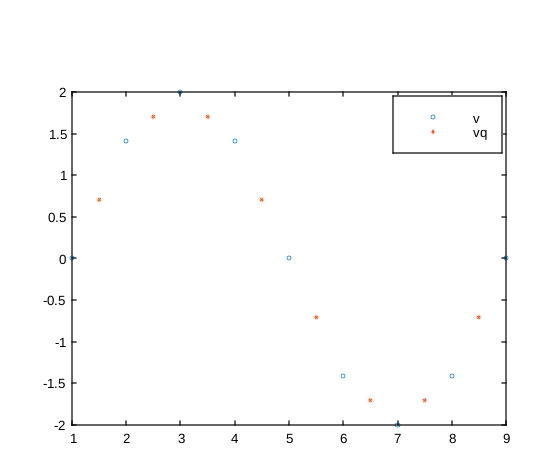
vq = interp1(x, v, xq)
vq = interp1(x, v, xq, method)
vq = interp1(x, v, xq, method, extrapolation)
vq = interp1(v, xq)
vq = interp1(v, xq, method)
vq = interp1(v, xq, method, extrapolation)
pp = interp1(x, v, method, 'pp')
| Parameter | Description |
|---|---|
| x | Sample points: vector. |
| v | Sample values: vector, matrix. |
| xq | Query points: scalar, vector, matrix. |
| method | Interpolation method: 'linear', 'nearest', 'next', 'previous', 'pchip', 'cubic', 'makima', or 'spline'. |
| extrapolation | 'extrap' or a scalar value. |
| Parameter | Description |
|---|---|
| vq | Interpolated values: scalar, vector, matrix. |
vq = interp1(x, v, xq) returns interpolated values of a 1-D function at specific query points. The default method is linear interpolation.
pp = interp1(x, v, method, 'pp') returns a piecewise polynomial structure that can be evaluated with ppval.
f = figure();
v = [0  1.41  2  1.41  0  -1.41  -2  -1.41 0];
xq = 1.5:8.5;
vq = interp1(v,xq);
plot(1:9, v, 'o', xq, vq, '*');
legend('v','vq');| Version | Description |
|---|---|
| 1.0.0 | initial version |