Examples
f = figure();
sys = tf([1 3], [1 3 2]);
rlocus(sys);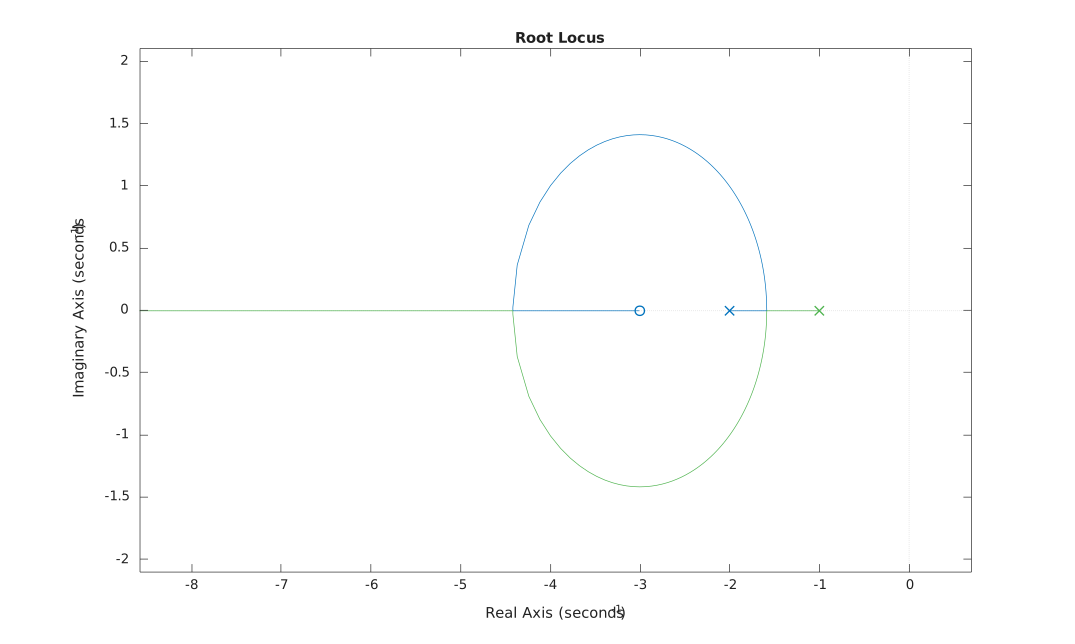
G = tf(1, [1 3 2]);
[r, k] = rlocus(G);rlocus(sys)
rlocus(sys, k)
rlocus(sys1, sys2, ...)
[r, k] = rlocus(sys)
[r, k] = rlocus(sys, k)
| Parameter | Description |
|---|---|
| sys | SISO dynamic system |
| k | Vector of feedback gains |
| Parameter | Description |
|---|---|
| r | Complex closed-loop pole locations, one column per gain |
| k | Vector of gains used |
The root locus function, rlocus(sys), computes and plots the locus of the closed-loop poles of the feedback loop feedback(k*sys, 1), that is the roots of den + k*num, as the gain k sweeps from 0 to infinity.
Each branch starts at an open-loop pole (marked x) for k = 0 and ends at a finite open-loop zero (marked o) or goes to infinity as k grows.
When a gain vector k is supplied, those gains are used instead of the automatically selected range.
With output arguments, [r, k] = rlocus(sys) returns the closed-loop pole locations and the gains without plotting.
f = figure();
sys = tf([1 3], [1 3 2]);
rlocus(sys);G = tf(1, [1 3 2]);
[r, k] = rlocus(G);| Version | Description |
|---|---|
| 1.0.0 | initial version |